

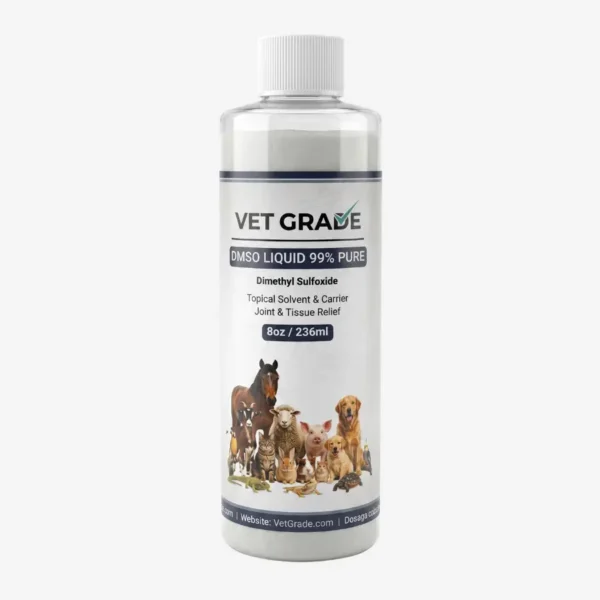
DMSO Liquid 99% Pure – Veterinary-Grade
$20.95 – $365.50Price range: $20.95 through $365.50
- For Dogs, Cats & Rabbits – Use strictly under veterinary guidance, especially in cats (see safety notes below).
- Targets Inflammation & Free Radical Damage – A potent free-radical scavenger and anti-inflammatory compound that works at the cellular level to calm swelling and support recovery.
- Addresses Key Symptoms – Helps with joint stiffness, localized swelling, and muscle soreness following trauma, intense exercise, or age-related wear.
- Precise Dosing – 99% pure liquid, diluted and measured with an oral syringe as directed by your veterinarian.
- Palatable Flavor Options – Chicken, tuna, apple, vanilla, or unflavored, to make dosing easier once properly diluted.
- Vetgrade.com’s Top Quality – Every bottle of Vet Grade DMSO undergoes strict purification to leave zero room for harmful residues.

More Products from This Brand
DMSO Liquid 99% Pure – Veterinary-Grade
$20.95 – $365.50Price range: $20.95 through $365.50
Description
DMSO Liquid 99% Pure is a highly refined dimethyl sulfoxide solution used in dogs, cats, and rabbits to support recovery from inflammation, swelling, and soft-tissue soreness. It works by neutralizing excess free radicals that build up when cells are stressed or damaged from trauma, intense exercise, or ongoing inflammation, while also increasing local circulation and helping stabilize cell membranes — the combined effect is less swelling and a faster return to normal tissue function. DMSO’s most well-established veterinary use is topical, applied directly to the skin over a sore or swollen area; oral or diluted-liquid use, as described on this page, is an extra-label application that should only be undertaken under a veterinarian’s specific direction, since it’s far less standardized than topical use. Vetgrade.com’s DMSO Solution is measured precisely with an oral syringe once diluted as your veterinarian directs.
Animals It’s Used For
Dogs
The species with the most veterinary experience behind it, primarily for topical inflammation and soft-tissue support; oral/diluted use is extra-label and less common.
Cats
Used with extra caution. Cats appear more sensitive to DMSO’s effects on red blood cells than dogs, so any internal use should be at the conservative end of the dosing range and only under close veterinary supervision.
Rabbits
Used occasionally under veterinary direction for localized swelling or soft-tissue soreness; long-term, high-dose exposure has been associated with reversible lens changes in laboratory studies, which is a reason to keep courses short and vet-supervised.
Symptoms & Indications
Signs DMSO Support May Help With
- Localized swelling or heat following an injury, sprain, or trauma
- Joint stiffness or soreness, especially in aging or working/athletic animals
- Muscle soreness after intense activity or exertion
- Slow, sluggish recovery from soft-tissue injury
Important Safety Notes
Dilute before oral use. 99% pure DMSO is concentrated enough to irritate the mouth and mucous membranes if given undiluted. Mix the measured dose thoroughly into a generous portion of wet food or a palatable liquid before offering it — this is the “dilution” step, and it isn’t optional.
Extra caution in cats. DMSO has been associated with red blood cell breakdown (hemolysis) in cats at higher doses in controlled studies. Stay at the conservative end of any dosing guidance and never increase the dose or frequency without your veterinarian’s direct input.
Skin and glove precautions. DMSO penetrates skin rapidly and can carry along whatever else is on your hands or your pet’s skin — dirt, residue, other topical products — straight into the bloodstream. Always wear gloves when measuring or handling this product, and keep it away from any skin that isn’t clean.
Freezing point. 99% pure DMSO solidifies (crystallizes) at approximately 65°F (18.5°C). If the liquid solidifies, place the tightly sealed bottle in a warm room or a bowl of warm water until it returns to liquid form — this doesn’t damage the product.
Avoid in animals with significant liver or kidney disease, and avoid in pregnant or nursing animals, without direct veterinary oversight.
Not for use on broken, irritated, or dirty skin, and only for internal/oral use when specifically directed and supervised by a veterinarian.
DMSO Liquid 99% Pure Dosing Chart
Important: Unlike our other products, there is no manufacturer-established or FDA-recognized oral dosing protocol for DMSO in dogs, cats, or rabbits. The figures below are extrapolated conservatively from the oral/IV dosing range published for large animals in the veterinary literature and are provided for general reference only. Do not use this chart as a substitute for a veterinarian’s specific instructions — this is one product where that guidance really matters.
| Species | Suggested Dose Range | Schedule | Approx. mL (99%) per 10 lb, before dilution |
|---|---|---|---|
| Dogs | 0.25–0.5 g/kg | Once daily, short course, per veterinary guidance | ~1.0–2.1 mL |
| Cats | 0.1–0.25 g/kg (conservative end only) | Once daily, short course, close veterinary supervision required | ~0.4–1.0 mL |
| Rabbits | 0.1–0.25 g/kg | Once daily, short course, veterinary supervision required | ~0.4–1.0 mL |
Always dilute the measured dose into a generous portion of wet food or a palatable liquid before offering it — never give the 99% pure liquid directly by mouth undiluted.
Dosing Instructions
- Put on gloves before handling or measuring this product.
- Confirm the exact dose and treatment length with your veterinarian before starting — this isn’t a product to dose from a general chart alone.
- Using a clean oral syringe, measure the required amount of 99% pure liquid.
- Dilute the measured dose thoroughly into a generous portion of wet food or a palatable liquid — never offer the undiluted liquid directly.
- If the bottle has solidified or shows crystals, warm it gently (a warm room or a bowl of warm water) until it liquefies before measuring a dose.
- Watch for a garlic- or oyster-like breath odor after dosing — this is a normal, harmless effect of DMSO, not a sign of a problem.
- Keep courses short and re-check with your veterinarian before continuing treatment beyond what was originally directed, especially in cats.
FAQs
Can DMSO Liquid 99% Pure be used in pregnant or nursing animals?
No — it’s not recommended for pregnant or lactating animals. If there’s no reasonable alternative, this should only happen under direct veterinary guidance.
Is there a withdrawal period for rabbits raised for meat?
This matters specifically for rabbits, since dogs and cats aren’t food-producing animals. DMSO doesn’t have a well-established withdrawal interval for rabbits in the published literature, largely because internal use in rabbits is uncommon and extra-label. If you’re treating a rabbit that could enter the food chain, talk to your veterinarian or contact FARAD before use rather than assuming a specific withdrawal window.
I thought DMSO was normally applied to the skin, not given by mouth — is that right?
Yes. The FDA-recognized veterinary use of DMSO (the approved product Domoso) is topical, applied to the skin over swelling or sore areas in dogs and horses. Oral or diluted internal use, as described on this page, is an extra-label application with much less standardized dosing data behind it, which is exactly why the guidance here leans conservative and repeatedly points back to your veterinarian.
Is this safe for my cat specifically?
Use extra caution. Cats have shown more sensitivity to DMSO’s effects on red blood cells than dogs in controlled studies, so internal use in cats should stay at the lowest end of any suggested range and only happen under close veterinary supervision — this isn’t a product to free-dose in cats.
My pet has garlicky-smelling breath after dosing — is something wrong?
No, this is one of DMSO’s best-known and harmless side effects. The odor comes from a breakdown product exhaled through the lungs and can last a day or more; it’s not a sign of toxicity on its own.
The liquid in the bottle turned cloudy or solid — is it ruined?
No. Pure DMSO solidifies at about 65°F (18.5°C), which is close to normal room temperature in a cool house. Warm the tightly sealed bottle in a warm room or a bowl of warm water until it liquefies again — this doesn’t affect potency.
Do I still need gloves if I’m just mixing this into my pet’s food?
Yes. DMSO absorbs through skin on contact, and it can carry along whatever else is on your hands. Wear gloves any time you’re measuring, diluting, or handling the concentrated liquid, even if the final step is mixing it into food.
How should it be stored, and what’s the shelf life?
Store tightly capped in the original container at room temperature (68–77°F / 20–25°C), away from direct sunlight, open flames, and incompatible materials (including certain plastics and rubber). Keep strictly out of reach of children and pets.
Sources
- Dimethyl Sulfoxide (DMSO) Topical — VCA Animal Hospitals
- Domoso Solution for Animal Use — Official Product Information, Drugs.com
- Standard Operating Procedure: Dimethyl Sulfoxide (DMSO) Use — UC Davis School of Veterinary Medicine
- RMTC Controlled Therapeutic Substances Monograph: Dimethyl Sulfoxide (DMSO)
Doses reflect commonly referenced veterinary ranges and are for general informational purposes. Always confirm exact dosing and treatment length with a veterinarian.
Reviews
There are no reviews yet.