

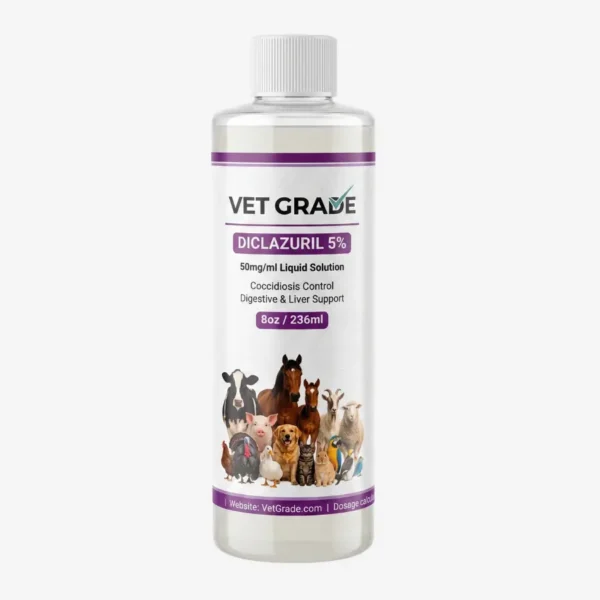
Vet Grade Diclazuril Liquid Solution
$17.95 – $253.25Price range: $17.95 through $253.25
- Multi-Species Use – Formulated for poultry & game birds, sheep, goats, cattle, pigs, rabbits, horses, dogs, and cats.
- Targets Two Key Conditions – Supports treatment of coccidiosis (Eimeria/Isospora species) across birds, livestock, rabbits, and companion animals, and Equine Protozoal Myeloencephalitis (EPM) in horses.
- Addresses Key Symptoms – Helps manage watery, pale, or bloody diarrhea, rapid weight loss or stunted growth, lethargy, drooping wings in birds, and dehydration.
- Easy Liquid Dosing – A 5% oral solution for simple, accurate weight-based dosing with an oral syringe, or mixed into drinking water for flocks and herds.
- Palatable Flavor Options – Chicken, tuna, apple, vanilla, or unflavored to make dosing easier across species.
- Vetgrade.com’s Top Quality – Every bottle of Vet Grade Diclazuril is made for consistent potency you can dose with confidence.

More Products from This Brand
Vet Grade Diclazuril Liquid Solution
$17.95 – $253.25Price range: $17.95 through $253.25
Description
Diclazuril Liquid Solution is a 5% oral antiprotozoal used to treat and help prevent coccidiosis in poultry, game birds, livestock, rabbits, dogs, and cats, and to treat Equine Protozoal Myeloencephalitis (EPM) in horses. It works by stopping the parasite from completing its life cycle in the animal’s body, so the gut (or, in the case of EPM, the nervous system) can start to recover. Diclazuril is actually FDA-approved for treating EPM in horses, making it one of the more established options for that condition. Because it’s a ready-to-use liquid, Vetgrade.com’s Diclazuril Solution is easy to dose accurately by weight with an oral syringe, or mixed into drinking water for flock and herd treatment.
Animals It’s Used For
Poultry & Birds
Chickens, turkeys, pheasants, quail, pigeons, ducks, and guinea fowl — treats and helps prevent intestinal coccidiosis (E. tenella, E. maxima, E. acervulina, E. adenoeides, and related species). Usually mixed into the flock’s drinking water or feed.
Livestock (Ruminants & Swine)
Lambs and sheep (E. ovinoidalis, E. crandallis), goats and kids, calves and cattle (E. bovis, E. zuernii), and piglets and swine (Cystoisospora suis).
Rabbits
Fattening and breeding rabbits — effective against both intestinal coccidiosis (E. magna, E. media) and hepatic (liver) coccidiosis (E. stiedai).
Horses
Foals and adult equines — treats EPM caused by Sarcocystis neurona (diclazuril’s FDA-approved use, sold under the brand Protazil), and is also used against intestinal coccidiosis (E. leuckarti) in foals.
Dogs & Cats
Puppies, kittens, and adults — used off-label to clear protozoal infections caused by Cystoisospora (Isospora) species, especially in high-density environments like shelters or catteries.
Symptoms & Indications
Coccidiosis Symptoms — Poultry, Livestock, Rabbits, Dogs & Cats
- Watery, pale, or bloody diarrhea (scours)
- Rapid weight loss, or failure to thrive/stunted growth
- Lethargy, drooping wings (in birds), or rough coat
- Dehydration and loss of appetite
EPM Symptoms — Horses
- Incoordination or a “wobbly,” uncoordinated gait (ataxia)
- Weakness, especially in the hindquarters
- Muscle atrophy, often asymmetric
- Facial drooping, head tilt, or difficulty swallowing
Diclazuril Liquid Solution Dosing Chart
Doses below reflect commonly referenced veterinary ranges and are for general informational purposes. Always confirm exact dosing and treatment length with a veterinarian.
Poultry & Game Birds
| Method | Dose | Schedule |
|---|---|---|
| Drinking water (flock) | ~1 mg diclazuril per liter of water (~0.75 mL of 5% solution per 10 gallons) | Once daily for 2 consecutive days |
| Individual/small flock, by weight | ~1 mg/kg body weight (~0.01 mL of 5% solution per lb) | Once daily for 2 days |
Livestock & Rabbits
| Species | Typical Dose | Schedule | mL per 10 lb body weight (5%) |
|---|---|---|---|
| Lambs & Sheep | 1 mg/kg (0.45 mg/lb) | Single dose, or split into 2 doses 3–4 weeks apart | 0.09 mL |
| Goats & Kids | ~1 mg/kg (0.45 mg/lb) | Single dose | 0.09 mL |
| Calves & Cattle | 5 mg/kg (2.3 mg/lb) | Single dose | 0.45 mL |
| Piglets & Swine | 5 mg/kg (2.3 mg/lb) | Single dose | 0.45 mL |
| Rabbits | 1 mg/kg (0.45 mg/lb) | Once daily, 2 days | 0.09 mL |
Horses (EPM)
| Dose | Schedule | mL per 100 lb body weight (5%) |
|---|---|---|
| 1 mg/kg (0.45 mg/lb) | Once daily for 28 days | 0.91 mL |
Dogs & Cats
| Species | Typical Dose | Schedule | mL per 10 lb body weight (5%) |
|---|---|---|---|
| Dogs | 10–30 mg/kg (4.5–13.6 mg/lb) | Once daily, 1–3 days | 0.91–2.73 mL |
| Cats | 5–25 mg/kg (2.3–11.4 mg/lb) | Single dose | 0.45–2.27 mL |
Dog and cat dosing has a wide reported range in clinical use — a veterinarian can help pinpoint the right dose within this range based on infection severity and the individual animal.
Dosing Instructions
- Shake the bottle thoroughly before each use to ensure a completely uniform solution.
- Weigh the animal (or use a recent known weight) for accurate dosing — never estimate by eye.
- Using a calibrated oral syringe, measure the exact required fluid volume.
- Administer directly into the side of the animal’s mouth, or mix thoroughly into a small, highly palatable portion of wet food or a liquid treat that will be consumed immediately.
- For flocks and herds, mix the calculated dose into drinking water and ensure it’s consumed within the treatment window.
- Because coccidiosis causes rapid fluid loss, always ensure treated animals have continuous access to fresh, clean drinking water during the recovery period.
- For multi-day or multi-week protocols (including the 28-day equine EPM protocol), dose at the same time each day and complete the full course even if symptoms improve early.
FAQs
Can diclazuril be used in pregnant animals? Safety in pregnancy hasn’t been well established for most species. Some sources describe it as generally safe in pregnant sheep, while others advise against use during pregnancy and lactation entirely. Given the mixed guidance, treating a pregnant or lactating animal should only be done under direct veterinary supervision.
Are there withdrawal periods for meat, milk, or eggs? Yes, though they vary by species and formulation. Some diclazuril products carry a meat withdrawal period as short as 5 days for poultry, and 0 days for some cattle and sheep formulations, but products are generally not approved for use in laying hens or in animals producing milk for human consumption. Always check the specific product label and confirm with your veterinarian before treating any food-producing animal.
How is diclazuril different from toltrazuril or ponazuril? All three belong to the same triazine/triazinone class of antiprotozoals and target similar parasites, but they’re distinct compounds with different dosing schedules and species data behind them. Diclazuril is notable for being FDA-approved specifically for EPM in horses (as Protazil), which gives it stronger official backing for that use than some alternatives.
How fast does it start working? For coccidiosis, many owners and producers report firmer stools and improved appetite within 24–72 hours of dosing. EPM treatment in horses is much slower, with improvement typically tracked over several weeks during the 28-day protocol.
Does my horse need a confirmed EPM diagnosis before starting treatment? Most veterinarians recommend diagnostic testing (bloodwork and/or spinal fluid analysis) before committing to the full 28-day protocol, since EPM symptoms can resemble other neurological or musculoskeletal conditions.
Can it be used for both intestinal and liver (hepatic) coccidiosis in rabbits? Yes — diclazuril has research support for both intestinal coccidiosis (E. magna, E. media) and hepatic coccidiosis (E. stiedai) in rabbits, which is one of the reasons it’s a common choice for breeding and fattening rabbit operations.
Is it safe to treat an entire flock or herd at once? Yes, that’s standard practice for poultry and livestock, and it’s often recommended in high-density or outbreak situations. Water or feed medication ensures more consistent dosing across a group than trying to dose each animal individually.
How should it be stored, and what’s the shelf life? Store at room temperature, out of direct sunlight, tightly capped. Shake before each use. Discard if the solution changes color, smells off, or is past the expiration date on the bottle.
Note: Doses reflect commonly referenced veterinary ranges and are for general informational purposes. Always confirm exact dosing and treatment length with a veterinarian.
Sources
- PROTAZIL (1.56% diclazuril) Antiprotozoal Pellets — Merck Animal Health / FDA-approved label
- Coccidiosis of Cats and Dogs — Merck Veterinary Manual
- Efficacy of diclazuril in the prevention and cure of intestinal and hepatic coccidiosis in rabbits — PubMed
- European Medicines Agency — Diclazuril MRL Assessment Report (all ruminants, porcine species)

Reviews
There are no reviews yet.