

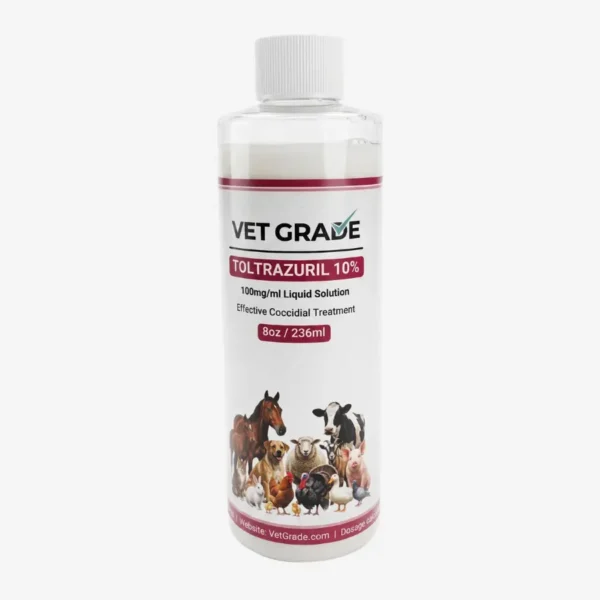
Toltrazuril Liquid Solution
$26.95 – $1,317.50Price range: $26.95 through $1,317.50
- Multi-Species Formula – Made for dogs, cats, rabbits, poultry/birds, goats, sheep, cattle, pigs, and horses.
- Targets Coccidiosis – Fights Eimeria and Isospora species, the protozoal parasites responsible for coccidiosis in pets and livestock; also supports horses undergoing veterinary care for Equine Protozoal Myeloencephalitis (EPM).
- Addresses Key Symptoms – Helps manage diarrhea, bloody stools, lethargy, dehydration, weight loss, and poor growth rate associated with protozoal infection.
- Easy Liquid Dosing – Available in 5%, 10%, and 20% concentrations for simple, accurate weight-based measuring — no pills or powder to mix.
- Palatable Flavor Options – Chicken, tuna, apple, vanilla, or unflavored to make dosing easier on stressed, sick, or picky animals.
- Flexible Bottle Sizes – From 4oz for a single pet up to 1-gallon (128oz) for farms, catteries, kennels, and rescues.
- Vetgrade.com’s Top Quality – Every batch of Vet Grade Toltrazuril is made for consistent potency and accurate labeling you can dose with confidence.

More Products from This Brand
Toltrazuril Liquid Solution
$26.95 – $1,317.50Price range: $26.95 through $1,317.50
Description
Vet Grade Toltrazuril Liquid Solution is an oral antiprotozoal that treats and helps prevent coccidiosis, an intestinal infection caused by Eimeria and Isospora species, by stopping the parasite from reproducing in the gut so digestion and stool can return to normal. In horses, toltrazuril is also used under veterinary direction to help manage Equine Protozoal Myeloencephalitis (EPM), a separate nervous system disease caused by a different organism. Because it’s a ready-to-use liquid, Vetgrade.com’s Toltrazuril Solution is easy to dose accurately by body weight with an oral syringe — simple for pet owners, breeders, and farms alike.
Animals It’s Used For
Dogs, cats, rabbits, poultry and pet birds, goats, sheep, cattle, pigs, and horses.
Symptoms & Indications of Coccidiosis
- Diarrhea (often watery or mucoid)
- Bloody stools
- Lethargy or weakness
- Dehydration
- Weight loss
- Poor growth rate or failure to thrive (especially in young/weanling animals)
Coccidiosis is most common in young, newly weaned, or stressed animals, and in crowded or high-density environments (kennels, catteries, barns, poultry houses).
Dosing Chart
Coccidiosis — Dogs, Cats, Rabbits, Poultry, Goats, Sheep, Cattle, Pigs
| Species | Typical Dose | Schedule | mL per 10 lb body weight — 5% | 10% | 20% |
|---|---|---|---|---|---|
| Dogs & Puppies | ~20 mg/kg (9 mg/lb) | Once daily, 1–3 days | 1.8 mL | 0.9 mL | 0.45 mL |
| Cats & Kittens | ~15 mg/kg (7 mg/lb) | Single dose; may repeat once if needed | 1.4 mL | 0.7 mL | 0.35 mL |
| Rabbits | ~20–25 mg/kg (10 mg/lb) | Once daily, 2 days | 1.8–2.3 mL | 0.9–1.1 mL | 0.45–0.55 mL |
| Poultry / Pet Birds | ~7 mg/kg (3 mg/lb) | Once daily, 2 days (or via drinking water for flocks) | 0.6 mL | 0.3 mL | 0.15 mL |
| Goats & Sheep | ~20 mg/kg (9 mg/lb) | Single dose | 1.8 mL | 0.9 mL | 0.45 mL |
| Cattle | ~15–20 mg/kg (8 mg/lb) | Single dose | 1.6–1.8 mL | 0.8–0.9 mL | 0.4–0.45 mL |
| Pigs (piglets) | ~20 mg/kg (9 mg/lb) | Single dose, often given days 3–5 of life for prevention | 1.8 mL | 0.9 mL | 0.45 mL |
| Pigs (adults) | ~10 mg/kg (4.5 mg/lb) | Single dose | 0.9 mL | 0.45 mL | 0.23 mL |
EPM Support — Horses (veterinary-directed use only)
| Dose | Schedule | mL per 100 lb body weight — 5% | 10% | 20% |
|---|---|---|---|---|
| 5–7.5 mg/kg (2.3–3.4 mg/lb) | Once daily for 28 days | 4.5–6.8 mL | 2.3–3.4 mL | 1.1–1.7 mL |
Dosing Instructions
- Weigh the animal (or use a recent known weight) for accurate dosing — never estimate by eye.
- Draw up the correct volume using an oral syringe sized to the dose (1mL, 3mL, or 5mL work well for most animals).
- Administer directly into the mouth (along the cheek pouch), mix into a small amount of wet food, or add to drinking water for flock/herd treatment.
- Shake well before each use.
- For multi-day protocols, dose at the same time each day and complete the full course even if symptoms improve early.
- Reintroduce fresh water and monitor stool consistency, appetite, and hydration for 48–72 hours after treatment.
- In group settings (catteries, kennels, barns, coops), consider treating all in-contact animals and disinfecting the environment to reduce reinfection risk.
FAQs
Can toltrazuril be used in pregnant animals? Safety in pregnancy hasn’t been fully established across all species, and data is limited. Some evidence in food-producing species suggests it can be used later in gestation under veterinary guidance, but manufacturers generally advise against use in pregnant or lactating dogs, especially during the first weeks of lactation, unless a veterinarian determines the benefit outweighs the risk. Always consult your veterinarian before dosing a pregnant or nursing animal.
What’s the difference between toltrazuril and ponazuril? Ponazuril (toltrazuril sulfone) is the active metabolite your animal’s body produces after toltrazuril is absorbed and processed by the liver. Toltrazuril converts internally into ponazuril, which is what reaches the bloodstream and, in small amounts, the central nervous system. This is why toltrazuril has activity against both intestinal coccidia and, over a longer course, Sarcocystis neurona in horses with EPM.
How fast does it start working? Many owners report firmer stools and improved energy within 24–72 hours of the first dose for coccidiosis. EPM protocols in horses take much longer — improvement is typically assessed over weeks, not days, since the full course runs about 28 days.
Is it normal for diarrhea to continue for a day or two after dosing? Yes. As the coccidia die off, mild diarrhea or reduced appetite can occur for 24–48 hours — this is a normal part of the parasite die-off, not necessarily a sign the treatment isn’t working. Contact your vet if diarrhea is severe, bloody, or persists beyond 3 days.
Can it be given to very young puppies, kittens, or newborn livestock? Toltrazuril is commonly used in young animals, including neonatal piglets and young puppies/kittens, but dosing must be adjusted precisely for their small body weight. Confirm dosing with a veterinarian for any animal under a few weeks old.
Do I need to repeat the dose or treat again later? Depends on the species, severity, and environment. Single-dose protocols are common for otherwise healthy animals, but a second dose or a short multi-day course may be needed for heavy infections or high-risk environments (shelters, breeding facilities, crowded pens). Follow-up fecal testing can confirm the infection has cleared.
Are there withdrawal periods for meat, milk, or eggs? Yes, in food-producing animals. Withdrawal times vary by species and jurisdiction — commonly cited ranges are roughly 2–3 weeks before slaughter for poultry meat and considerably longer for cattle, sheep, goats, and pigs. Products are generally not intended for use in animals producing milk or eggs for human consumption. Check current label guidance and consult a veterinarian before treating any animal in food production.
Is coccidiosis contagious to humans? The Eimeria and Isospora species that cause coccidiosis in dogs, cats, poultry, and livestock are generally host-specific and are not the same organism as Cryptosporidium, which is zoonotic. Standard hygiene (handwashing, disinfecting bedding/enclosures) is still recommended when handling any sick animal.
How should it be stored, and what’s the shelf life? Store at room temperature, out of direct sunlight, tightly capped. Shake before each use. Discard if the solution changes color, smells off, or is past the expiration date on the bottle.
Can toltrazuril be given alongside dewormers or antibiotics? It’s generally compatible with most standard dewormers and antibiotics, but always tell your veterinarian everything the animal is currently taking before starting treatment to rule out interactions specific to that animal’s health status.
Reviews
There are no reviews yet.