

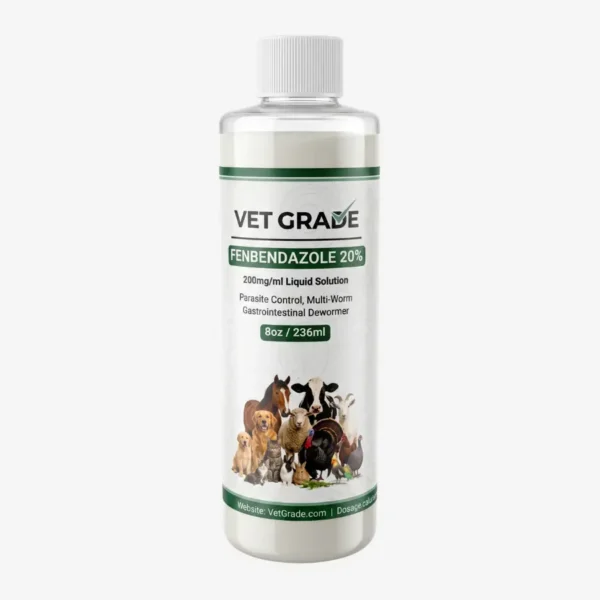
Fenbendazole Liquid Dewormer
$14.95 – $297.45Price range: $14.95 through $297.45
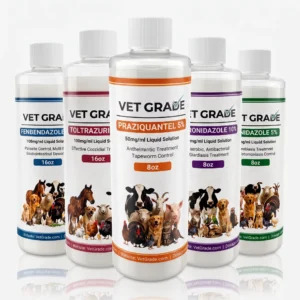
- Widest Species Coverage in Our Lineup – Formulated for horses, dogs, cats, rabbits, goats, sheep, cattle, pigs/swine, birds, and reptiles.
- Broad-Spectrum Dewormer – Clears roundworms, hookworms, whipworms, some tapeworms, lungworms, and (off-label) Giardia — but does not treat coccidia, so pair it with one of our coccidiostats if that’s the issue.
- Addresses Key Symptoms – Helps manage diarrhea (sometimes greasy or chronic), visible worms, weight loss or poor growth, dull coat, coughing, and lethargy.
- Easy Liquid Dosing – Available in 10% and 20% concentrations for accurate weight-based dosing with an oral syringe.
- Palatable Flavor Options – Chicken, tuna, apple, vanilla, or unflavored for easier dosing across species.
- Vetgrade.com’s Top Quality – Every bottle of Vet Grade Fenbendazole is made for consistent potency you can dose with confidence.

More Products from This Brand
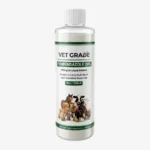
Fenbendazole Liquid Dewormer
$14.95 – $297.45Price range: $14.95 through $297.45
Description
Fenbendazole Liquid Dewormer is a broad-spectrum oral dewormer available in 10% and 20% concentrations, used across more species than almost any other anthelmintic — horses, dogs, cats, rabbits, goats, sheep, cattle, pigs, birds, and reptiles. It works by starving the worm’s cells of energy over several days of exposure, which is why it’s typically given once daily for a short consecutive-day course rather than as a single dose. Fenbendazole also has one of the best-documented safety profiles in pregnancy of any dewormer, and is even used deliberately in pregnant dogs to reduce hookworm and roundworm transmission to puppies. Because it’s a ready-to-use liquid, Vetgrade.com’s Fenbendazole Solution is easy to dose accurately by weight with an oral syringe.
Animals It’s Used For
Dogs & Cats
Clears roundworms, hookworms, whipworms, and some tapeworm species (Taenia pisiformis); also used off-label for Giardia.
Horses
Controls large and small strongyles and roundworms at the standard dose; a longer, higher-dose protocol targets encysted small strongyle (cyathostomin) larvae specifically.
Cattle, Sheep & Goats
Treats stomach worms, lungworms, and other GI nematodes; labeled for goats at the standard dose, with higher doses considered extra-label.
Pigs / Swine
Controls roundworms and lungworms.
Rabbits
Used for general GI parasites on a short course, and — at a much lower dose given over a much longer course — as part of treatment protocols for Encephalitozoon cuniculi, a different parasite entirely from intestinal worms.
Birds & Reptiles
Used against roundworms and other intestinal parasites; dosing varies more by species and body size here than in any other group, so extra care (and often an exotics-experienced vet) is worthwhile.
Symptoms & Indications
Signs of Worm Burden
- Diarrhea — may be chronic, intermittent, or greasy-looking (especially with Giardia)
- Visible worms in stool or vomit
- Weight loss, poor growth, or a pot-bellied appearance in young animals
- Dull or rough coat
- Coughing (can indicate lungworm involvement, particularly in cattle and horses)
- Lethargy
Fenbendazole does not treat coccidiosis — if your animal’s symptoms are pointing to coccidia rather than worms, one of our coccidiostat products (toltrazuril, ponazuril, diclazuril, or amprolium) is the more appropriate choice.
Important Safety Notes
Bone marrow effects with prolonged or excessive use. At standard labeled doses and durations, fenbendazole is very well tolerated. Rare cases of bone marrow suppression (leading to low blood cell counts) have been reported in dogs, but almost exclusively with unusually long or high-dose use well beyond the standard 3–5 day course — not with normal, label-directed deworming.
On “fenbendazole cancer protocols”: You may have come across online discussions (originating from a single, unverified human anecdote) suggesting high-dose, long-term fenbendazole as a cancer treatment for dogs. This is not an approved or veterinarian-established use, there’s no controlled veterinary evidence supporting it, and there are reports of liver injury associated with these unsupervised high-dose regimens. Any use for cancer support should only be considered in direct partnership with your veterinarian or a veterinary oncologist — this product is intended and dosed for standard parasite control.
Fenbendazole Liquid Solution Dosing Chart
Doses below reflect commonly referenced veterinary ranges and are for general informational purposes. Always confirm exact dosing and treatment length with a veterinarian.
Dogs & Cats
| Dose | Schedule | mL per 10 lb body weight (10%) | (20%) |
|---|---|---|---|
| 50 mg/kg (22.7 mg/lb) | Once daily, 3 days (up to 5 for some cases) | 2.27 mL | 1.14 mL |
Do not extend treatment beyond what your veterinarian recommends — there’s no added benefit to longer courses, and it raises the (still uncommon) risk of side effects.
Horses
| Purpose | Dose | Schedule | mL per 100 lb body weight (10%) | (20%) |
|---|---|---|---|---|
| Standard strongyles/roundworms | 5 mg/kg (2.3 mg/lb) | Single dose | 2.27 mL | 1.14 mL |
| Encysted small strongyles | 10 mg/kg (4.5 mg/lb) | Once daily, 5 consecutive days | 4.55 mL | 2.27 mL |
Cattle
| Dose | Schedule | mL per 100 lb body weight (10%) | (20%) |
|---|---|---|---|
| 5 mg/kg (2.3 mg/lb) | Single dose (some lungworm protocols use a short multi-day course) | 2.27 mL | 1.14 mL |
Goats & Sheep
| Dose | Schedule | mL per 10 lb body weight (10%) | (20%) |
|---|---|---|---|
| 5 mg/kg (2.3 mg/lb) | Single dose | 0.23 mL | 0.11 mL |
Higher doses (up to 10 mg/kg) are used in some extra-label protocols for resistant parasites — only under veterinary direction.
Pigs / Swine
| Dose | Schedule | mL per 10 lb body weight (10%) | (20%) |
|---|---|---|---|
| ~9 mg/kg (4.1 mg/lb) | Single dose or short course per vet guidance | 0.41 mL | 0.20 mL |
Rabbits
| Purpose | Dose | Schedule | mL per 10 lb body weight (10%) | (20%) |
|---|---|---|---|---|
| General GI parasites | 5–10 mg/kg (2.3–4.5 mg/lb) | Once daily, 3 days | 0.23–0.45 mL | 0.11–0.23 mL |
| E. cuniculi protocol | 20 mg/kg (9 mg/lb) | Once daily, 28 days | 0.91 mL | 0.45 mL |
These are two very different protocols for two different parasites — don’t substitute one for the other without veterinary guidance.
Birds & Reptiles
| Species | Dose | Schedule |
|---|---|---|
| Birds | ~5 mg/kg body weight | Once daily, 3 days |
| Reptiles | 50–100 mg/kg body weight | Single dose, repeated in 2 weeks, or once daily for 3–5 days |
Doses for small birds often work out to well under 0.05 mL, which is hard to measure precisely with a standard syringe — an avian or exotics veterinarian can help with accurate dilution and measuring for very small patients.
Dosing Instructions
- Shake the bottle vigorously before every single use to ensure the active solution is completely uniform.
- Weigh the animal (or use a recent known weight) for accurate dosing.
- Using a calibrated oral syringe, measure the exact fluid volume required based on the animal’s current weight.
- Administer directly into the side of the mouth, or mix thoroughly into a small, highly palatable portion of wet food or a liquid treat, ensuring the entire treated meal is eaten immediately.
- For most active infestations, give once daily for 3 consecutive days to ensure full eradication of targeted worm species — fenbendazole relies on continuous exposure over several days to work fully.
- Always consult your veterinarian for specific re-treatment timelines, especially for longer protocols like encysted strongyle treatment in horses or E. cuniculi treatment in rabbits.
FAQs
Can fenbendazole be used in pregnant animals? Yes — fenbendazole has one of the strongest safety records in pregnancy of any dewormer, and is used across species including pregnant and lactating dogs, cattle, and sheep at labeled doses. It’s even used deliberately in pregnant dogs (starting around day 40 of gestation through 2 weeks after whelping) to reduce hookworm and roundworm transmission to the puppies. That said, doses far above label (roughly 3x or more) have been linked to developmental effects in studies, so stick to labeled or vet-directed doses.
Are there withdrawal periods for meat or milk? Yes, and they’re longer than some other dewormers, especially for milk. Reported figures include around 8 days meat withdrawal and 48 hours milk discard for cattle (some formulations list up to 13 days meat and 60 hours milk), 6 days meat withdrawal for goats (with no established milk withdrawal — don’t use in lactating goats producing milk for consumption), and up to 36 days milk withholding reported for sheep. Horses are not intended for human consumption in the US regardless of treatment. Always check your specific product label and confirm with your veterinarian or FARAD before treating a food-producing animal.
Is it true fenbendazole doesn’t treat coccidiosis? Correct — fenbendazole targets worms (nematodes and some cestodes), not coccidia. If diarrhea or other symptoms are being caused by coccidiosis, you’ll want one of our coccidiostat products instead, and a fecal test from your vet can confirm which parasite you’re actually dealing with.
How long can I safely treat with fenbendazole? For standard parasite control, 3 consecutive days is the typical course (occasionally extended to 5). Rare bone marrow side effects reported in dogs have been associated almost exclusively with unusually long or high-dose use well outside normal label directions — not standard short courses.
I’ve seen people online using fenbendazole for cancer in dogs — is that something you’d recommend? No. That protocol is based on a single unverified human case and hasn’t been established or validated by veterinary medicine, and unsupervised high-dose long-term use has been linked to liver injury in some reports. If you’re interested in exploring this, it needs to be a conversation with your veterinarian or a veterinary oncologist, not a self-directed regimen — this product is dosed and intended for routine parasite control.
Why does my rabbit’s dose look so different depending on what we’re treating? Fenbendazole is used at a low dose for a short course (3 days) for ordinary GI worms, but at a much higher dose for a full 28 days for E. cuniculi, a completely different parasite that affects the nervous system and kidneys. These aren’t interchangeable — the right protocol depends on what’s actually being treated.
How should it be stored, and what’s the shelf life? Store at room temperature, out of direct sunlight, tightly capped. Shake before each use. Discard if the solution changes color, smells off, or is past the expiration date on the bottle.
Note:
Doses reflect commonly referenced veterinary ranges and are for general informational purposes. Always confirm exact dosing and treatment length with a veterinarian.
Sources
- Safe-Guard® (fenbendazole) — Official FDA Label, DailyMed
- FDA Approves First Generic Fenbendazole Oral Suspension Dewormer for Beef and Dairy Cattle, Goats — FDA
- Withholding Periods After Anthelmintic Treatment in Animals — Merck Veterinary Manual
- Bone Marrow Hypoplasia Associated With Fenbendazole Administration in a Dog — PubMed
Reviews
There are no reviews yet.