

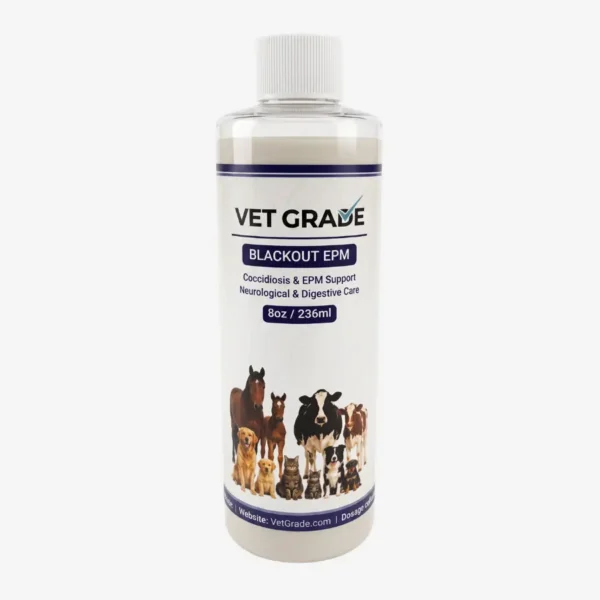
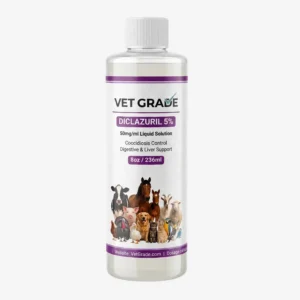
Blackout Coccidia Solution
$40.95 – $470.15Price range: $40.95 through $470.15
- For Horses, Dogs, Cats, Rabbits, Goats, Sheep, Cattle & Birds – A three-ingredient triazine antiprotozoal solution.
- Targets Coccidia in All Listed Species, and EPM in Horses Specifically – Combines toltrazuril, ponazuril, and diclazuril for broad-spectrum coccidial coverage, plus EPM support in horses (a diagnosis unique to that species).
- Addresses Key Symptoms – Helps with diarrhea (sometimes with blood or mucus), weight loss, poor coat or feather condition, and abdominal discomfort from coccidiosis; in horses specifically, also supports recovery from EPM-related incoordination and muscle weakness.
- Easy Liquid Dosing – A 50 mg/mL (per ingredient) oral solution for accurate weight-based dosing with an oral syringe.
- Palatable Flavor Options – Chicken, tuna, apple, vanilla, or unflavored.
- Vetgrade.com’s Top Quality – Every bottle of Vet Grade Blackout Coccidia Solution is made for consistent potency you can dose with confidence.

More Products from This Brand

Blackout Coccidia Solution
$40.95 – $470.15Price range: $40.95 through $470.15
Description
Blackout Coccidia Solution is a triple-ingredient oral antiprotozoal, combining toltrazuril, ponazuril, and diclazuril at 50 mg/mL each, for use in horses, dogs, cats, rabbits, goats, sheep, cattle, and birds. All three ingredients belong to the triazine/triazinone class and work the same general way — disrupting the internal structures that coccidia and related protozoa need to divide, which stops the infection from spreading through the gut lining so the animal’s body can heal and recover normal digestion. In horses specifically, this same drug class is also the foundation of FDA-approved treatment for EPM (Equine Protozoal Myeloencephalitis), a neurologic infection unique to horses. Because it’s a ready-to-use liquid, Vetgrade.com’s Blackout Coccidia Solution is easy to dose accurately by weight with an oral syringe.
Animals It’s Used For
Horses
Used for both coccidiosis and EPM. EPM is a horse-specific neurologic disease caused by Sarcocystis neurona (carried by opossums), and it’s the reason ponazuril and diclazuril — both ingredients in this formula — are FDA-approved as standalone equine antiprotozoal treatments. A suspected EPM case should be diagnosed by a veterinarian (often with bloodwork and spinal fluid testing) before starting a dedicated treatment course, since EPM protocols run longer and differ from a standard coccidiosis course.
Dogs, Cats & Rabbits
Used for coccidiosis, particularly in young, shelter, breeding-facility, or multi-animal environments where coccidia spread easily.
Goats, Sheep & Cattle
Used for coccidiosis, especially in young or recently weaned animals and in group housing where oocyst exposure is high. Important: because cattle, sheep, and goats can be food-producing animals, see the withdrawal period note below before treating any animal intended for meat or dairy.
Birds
Used for coccidiosis in poultry, pigeons, and other companion or backyard birds. Important: the same food-animal withdrawal caution applies to birds raised for meat or eggs.
Symptoms & Indications
EPM Symptoms (Horses Only)
- Loss of coordination or a staggering, uneven gait
- Muscle weakness or visible muscle atrophy (often asymmetric)
- Behavioral changes such as lethargy or unusual anxiety
- Difficulty eating or drinking
Coccidia Symptoms (All Listed Species)
- Diarrhea, sometimes containing blood or mucus
- Weight loss or poor growth in young animals
- Poor coat or feather condition
- Abdominal discomfort or bloating
- Dehydration
Important Safety Notes
This is a three-ingredient combination — understand the overlap. Ponazuril is the active metabolite that toltrazuril breaks down into inside the body, so this formula delivers meaningfully overlapping drug exposure from those two ingredients rather than two fully independent modes of action. Diclazuril is chemically distinct and contributes genuine additional coverage. This isn’t necessarily a problem, but it’s different from a single-ingredient product, and it’s worth discussing with your veterinarian, especially for repeated or long-term use.
Withdrawal periods in food-producing animals are driven by the slowest-clearing ingredient. Toltrazuril has a notably long withdrawal period in livestock — commonly cited at 63 days for cattle, sheep, and goats, and around 70 days for pigs — compared to diclazuril’s much shorter published withdrawal window (commonly cited around 5 days). Because this product contains toltrazuril, the longer withdrawal period applies to the whole product, not the shorter one. See the FAQ below, and confirm the current requirement with your veterinarian or FARAD before treating any animal intended for meat, milk, or eggs.
EPM should be diagnosed, not assumed. The neurologic signs associated with EPM can look similar to other equine conditions (injury, other neurologic disease). Don’t start a dedicated EPM treatment course based on symptoms alone — work with your veterinarian to confirm the diagnosis first.
Avoid in pregnant or nursing animals unless directed by a veterinarian, and use with caution in young or debilitated animals of any species.
Blackout Coccidia Solution Dosing Chart
Doses below reflect commonly referenced veterinary ranges and are for general informational purposes. Because this is a fixed three-ingredient combination, the dose of each individual active ingredient can’t be adjusted separately — always confirm exact dosing and treatment length with a veterinarian, especially for a confirmed EPM case.
| Species / Use | Approx. Dose (per active ingredient) | Schedule | mL per 10 lb body weight |
|---|---|---|---|
| Dogs, Cats, Rabbits — Coccidiosis | ~20 mg/kg | Once daily, 3–5 days | ~1.8 mL |
| Goats, Sheep, Cattle — Coccidiosis | ~20 mg/kg | Once daily, 3–5 days | ~1.8 mL |
| Birds — Coccidiosis | ~20 mg/kg | Once daily, 3–5 days, or mixed into water for flocks | ~1.8 mL per 10 lb equivalent (adjust for flock water intake) |
| Horses — Coccidiosis | ~20 mg/kg | Once daily, 3–5 days | ~1.8 mL per 10 lb |
| Horses — EPM (vet-confirmed diagnosis) | Per veterinary protocol, typically anchored to labeled ponazuril (5 mg/kg) or diclazuril (1 mg/kg) equine EPM rates | Once daily for 28 days, per veterinary guidance | Vet-calculated — do not estimate from the coccidiosis rate above |
The EPM row is intentionally left without a general at-home volume figure. Because two different FDA-labeled equine antiprotozoals in this formula (ponazuril and diclazuril) have different independently studied EPM dose rates (5 mg/kg and 1 mg/kg respectively), and because EPM treatment runs a full 28-day course, your veterinarian needs to calculate this dose specifically for a confirmed case rather than using the general coccidiosis rate above.
Dosing Instructions
- Shake the bottle thoroughly before each use to ensure a completely uniform solution.
- Weigh the animal (or use a recent known weight) for accurate dosing.
- Using a calibrated oral syringe, measure the exact fluid volume required for coccidiosis treatment, or use your veterinarian’s specific calculated volume for a confirmed EPM case.
- Administer directly into the mouth, or mix thoroughly into a small portion of wet food, feed, or drinking water that will be consumed promptly.
- For coccidiosis, complete the full 3–5 day course even if stool improves early.
- For horses being treated for confirmed EPM, complete the full veterinarian-directed course (commonly 28 days) — stopping early is a common reason for relapse or incomplete recovery.
- If treating a food-producing animal (cattle, sheep, goats, or birds raised for meat or eggs), confirm the withdrawal period with your veterinarian before treatment, given the extended interval driven by the toltrazuril component.
FAQs
Can Blackout Coccidia Solution be used in pregnant or nursing animals?
Generally, it should be avoided unless your veterinarian determines there’s no reasonable alternative. Safety data specific to this combination in pregnancy is limited, so this is a case-by-case veterinary decision.
Is there a withdrawal period for meat, milk, or eggs?
Yes, and it’s longer than you might expect from the diclazuril component alone. Because this product also contains toltrazuril, whose published withdrawal periods run around 63 days for cattle, sheep, and goats and about 70 days for pigs, that longer interval governs the whole product for food-producing animals — not diclazuril’s much shorter window. Always confirm the current recommended withdrawal period with your veterinarian or FARAD before treating any animal that could enter the food or dairy supply.
My goat/dog/rabbit was diagnosed with coccidia — does that mean it has EPM too?
No. EPM (Equine Protozoal Myeloencephalitis) is a horse-specific diagnosis caused by a particular parasite carried by opossums, and it doesn’t occur in goats, dogs, rabbits, or the other species this product covers. Those species can get coccidiosis, which this product treats, but “EPM” specifically refers to the neurologic horse disease. If your non-horse animal has neurologic symptoms, that has a different cause and needs its own veterinary workup.
Why combine three similar drugs instead of just using one?
Diclazuril works differently enough from toltrazuril and ponazuril to add real additional coverage, and using multiple triazine compounds is a strategy sometimes used to broaden coverage across a parasite’s life cycle. That said, toltrazuril and ponazuril overlap significantly since one converts into the other in the body — worth knowing if you’re deciding between this combination product and one of our single-ingredient options like toltrazuril or ponazuril alone.
How do I know if my horse actually has EPM and not something else?
You can’t reliably tell from symptoms alone — other neurologic and even some orthopedic conditions can look similar. A veterinarian can confirm EPM through a neurologic exam and blood or spinal fluid testing. Starting a 28-day EPM protocol without a diagnosis risks missing the real problem.
How long until I see improvement?
For coccidiosis, most animals show improved stool consistency within a few days of starting the 3–5 day course. For confirmed EPM in horses, improvement is typically gradual over the full 28-day course, and full recovery can take longer depending on how advanced the case was before treatment started.
How should it be stored, and what’s the shelf life?
Store at room temperature, out of direct sunlight, tightly capped. Shake before each use. Discard if the solution changes color, smells off, or is past the expiration date on the bottle.
Sources
- Equine Protozoal Myeloencephalitis (EPM) — American Association of Equine Practitioners (AAEP)
- MARQUIS (ponazuril) Antiprotozoal Oral Paste — Official FDA Label, DailyMed
- PROTAZIL (1.56% diclazuril) Antiprotozoal Pellets — Official FDA Label, DailyMed
- Withholding Periods After Anthelmintic Treatment in Animals — Merck Veterinary Manual
Doses reflect commonly referenced veterinary ranges and are for general informational purposes. Always confirm exact dosing and treatment length with a veterinarian.
Reviews
There are no reviews yet.